Blog Detail
Mehrangarh Fort Jodhpur: Complete Guide to History, Timings, Tickets & the Best Views

Mehrangarh Fort Jodhpur: Complete Guide to History, Timings, Tickets & the Best Views
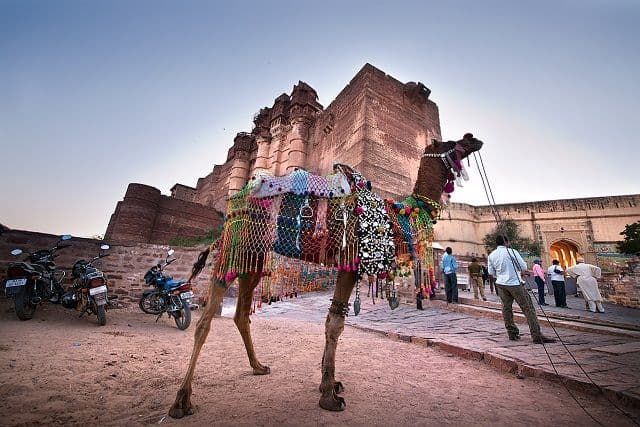
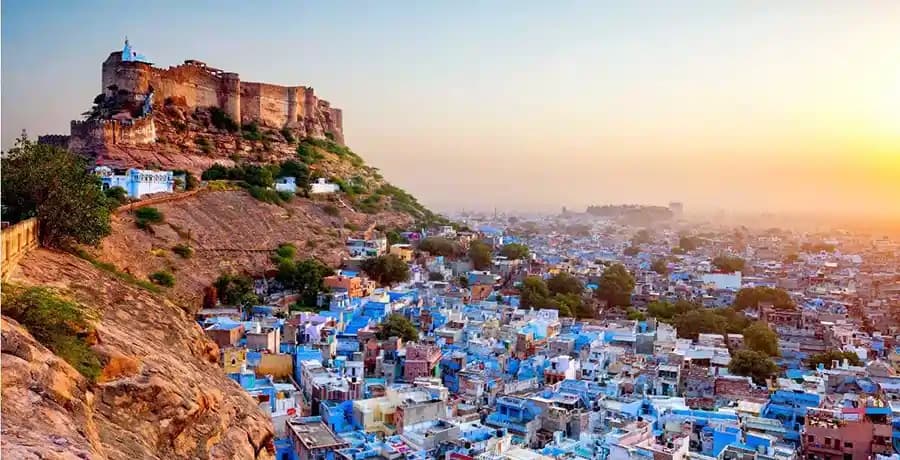
Mehrangarh Fort sits on a perpendicular rock face 125 metres above Jodhpur's old city. The approach from the town below — through the narrow lanes of the Blue City, past the indigo-painted houses that give Jodhpur its epithet — does not prepare you for the scale of the structure until you are standing directly beneath it and the walls above you are still forty metres higher.
It is, by general agreement among the people who have spent time comparing the forts of Rajasthan, the most impressive of them. Not the largest, not the most celebrated, but the most visually commanding and the most complete. This is the guide to visiting it properly.
The history of Mehrangarh Fort
Founded in 1459 by Rao Jodha, the chief of the Rathore Rajput clan who gave Jodhpur its name, Mehrangarh was constructed on a site called Bhakurcheeria — the Mountain of Birds — after the existing hill settlement was cleared. A hermit named Cheeria Nathji who refused to leave was reportedly buried in the foundations of the new fort, and the subsequent travails of the Jodhpur royal family have been attributed, with varying credibility, to this founding act. A memorial to Cheeria Nathji stands within the fort precincts.
The fort was expanded by successive Rathore rulers over three centuries. The seven gates on the ascent road are the most visible record of this expansion: Jayapol was built by Maharaja Man Singh in 1806 to celebrate his victory over the Jaipur and Bikaner forces; Fattehpol was built by Maharaja Ajit Singh to commemorate his victory over the Mughals; Loha Pol (Iron Gate) is the innermost and oldest gate, where the handprints of the sati women — queens and concubines who immolated themselves on the funeral pyres of the maharajas — are preserved in stone on the wall beside it.
Visiting Mehrangarh: practical information
Entry fees and tickets
Indian nationals: Rs 100 (adults), Rs 50 (children aged 5–18). Foreign nationals: Rs 600 (adults). Camera fee: Rs 100. A premium audio guide in multiple languages (including English, Hindi, French, German, Spanish and Mandarin Chinese) is available at the ticket counter — at Rs 200 it is one of the best-value audio guides in Rajasthan and covers the museum in sequence.
Tickets are available at the Jai Pol (first gate) ticket counter. Online booking is available through the official Mehrangarh Museum Trust website and avoids the queue at the gate during peak season.
Timings
Open daily, 9:00 AM to 5:30 PM. The last entry is at 5:00 PM. The fort closes for the Navratri festival during a portion of October — confirm dates in advance if visiting around that period.
Getting there
On foot from the Blue City: the approach through the old city lanes on the winding route to Jai Pol is the correct way to arrive at Mehrangarh. Walking through the narrow lanes, past the blue houses, up the incline toward the fort gates, gives you the scale of the structure from below before you enter it from above. Allow thirty to forty-five minutes from the old city's commercial centre.
By road: the main vehicle access road reaches a car park near the fort. Private vehicles and auto-rickshaws can drop at the base of the final ascent. Avoid driving through the old city lanes in a large vehicle.
Inside the fort: what to see and in what order
The seven gates
The ascent to the main fort precincts passes through seven successive gates, each with a specific historical significance. The cannonball marks on Jai Pol — fired by the forces of Jaipur — are still visible. The handprints at Loha Pol are the most emotionally charged detail on the entire ascent.
The museum
Mehrangarh houses one of the finest palace museums in Rajasthan, spread across the former royal apartments. The collection includes palanquins, elephant howdahs, ceremonial armour, miniature paintings from the Marwar school, textiles, and the largest collection of Rajput royal objects in the state. The Phool Mahal (Flower Palace) — the royal audience hall — has a painted ceiling with pure gold leaf and mirror work that is the architectural highlight of the interior.
Plan two hours minimum for the museum. With the audio guide, two and a half to three hours for a thorough visit.
The ramparts and views
The ramparts are the reason most visitors come. Walking the walls around the perimeter of the fort, looking down over the blue city spread below and the Thar Desert beyond, is one of the most satisfying viewpoints in India. The blue of the houses — a tradition attributed variously to Brahmin caste marking and to the deterrence of insects — is most visible from the northern rampart in the morning light.
The view south toward the Jaswant Thada cenotaph (a marble memorial to Maharaja Jaswant Singh II, built in 1899) and the clock tower beyond it composes naturally. The view north and west toward the city spreading to the horizon and the Thar beyond is what makes Mehrangarh's height meaningful.
The best views of Mehrangarh from outside
The fort looks as dramatic from below as from within. The three best external viewpoints:
From the old city lanes below Loha Pol: Looking up through the narrow lanes with the fort wall rising directly above. Best in the morning when the light hits the stone from the east.
Jaswant Thada: The white marble cenotaph 500 metres northeast of the fort provides an unobstructed view of the full south face of Mehrangarh. Sunrise from Jaswant Thada with the fort turning gold is the standard photograph.
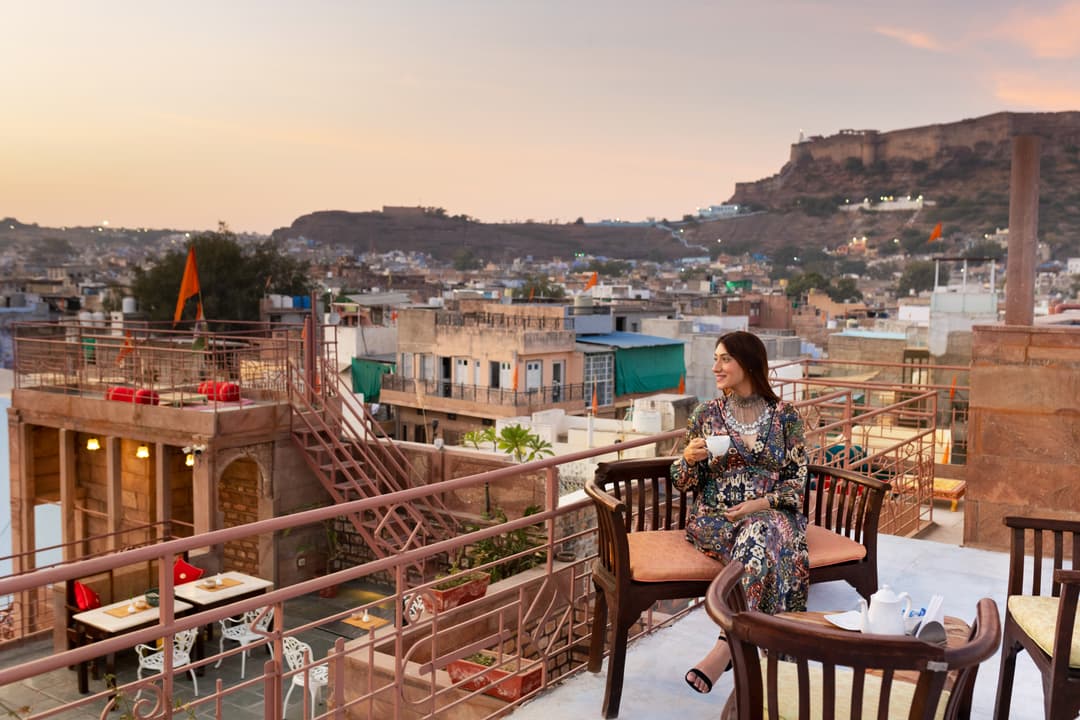
From a rooftop restaurant in the old city: Multiple restaurants in the lanes below the fort have rooftop seating with direct fort views. Sunset from these positions, with the fort lit from the west and the blue city in front of it, is the definitive Jodhpur image.
The advantage of staying in the old city
Most hotels in Jodhpur — including the majority of the large properties — sit in the newer development south and east of the old city. Reaching the fort from these hotels requires a vehicle. The experience of the fort is a day trip from a hotel that could be anywhere.
Staying within the old city changes this. The fort is a ten-minute walk. The market lanes, the clock tower, the Sardar Market — all within the same walking distance. The city sounds and the evening light on the blue houses from a rooftop are part of the daily experience rather than a dedicated excursion.
Where to stay: Amritara Manak Haveli
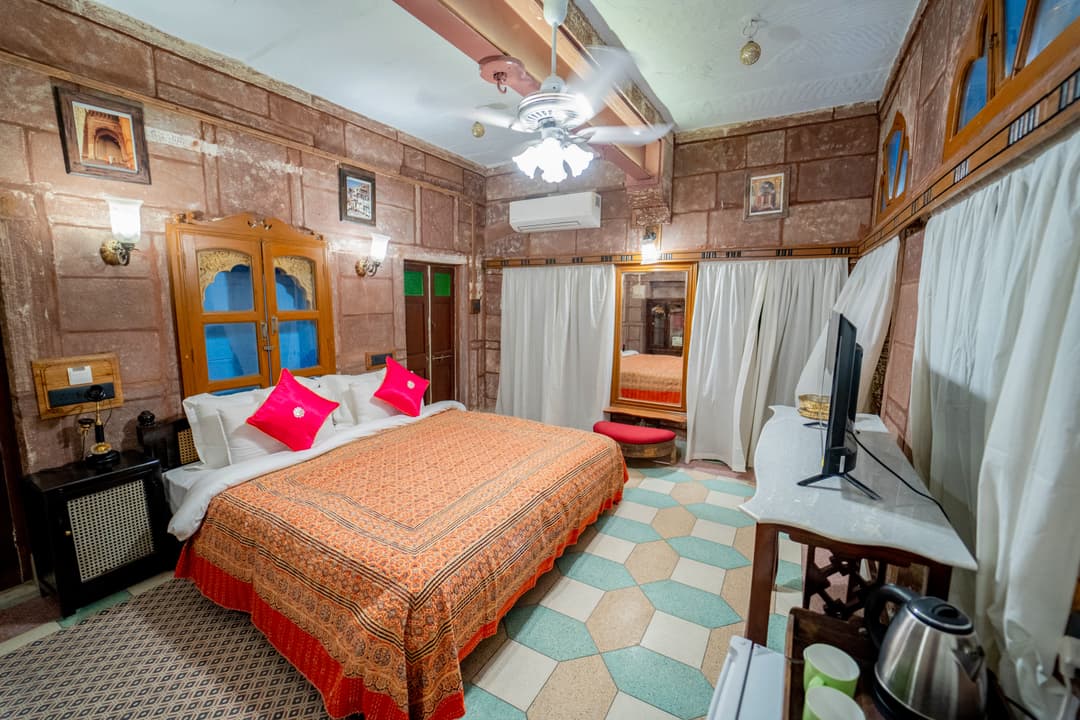
Manak Haveli is a restored heritage haveli in Goldsmith Lane — inside the old city, adjacent to Mehrangarh Fort. The rooftop restaurant looks directly onto the fort. The library, the manicured gardens, and the open-deck jacuzzi are the haveli's facilities; the Blue City and the fort are its surroundings.
The Maharani Room is the property's premium suite. Breakfast on the rooftop with Mehrangarh visible above the roofline is the specific experience that a property in this location and no other can offer.
Book Amritara Manak Haveli, Jodhpur
Inside the Blue City, next to the fort — book at amritara.co.in
Frequently asked questions
What is the entry fee for Mehrangarh Fort?
Indian nationals: Rs 100 for adults, Rs 50 for children. Foreign nationals: Rs 600. Camera fee Rs 100. Audio guide (highly recommended) Rs 200. Tickets available at the gate or online through the Mehrangarh Museum Trust website.
What time does Mehrangarh Fort open and close?
Open daily 9:00 AM to 5:30 PM. Last entry at 5:00 PM. Closed or restricted during parts of the Navratri festival in October — confirm dates if visiting at that time.
How long should I spend at Mehrangarh Fort?
Two to three hours for the museum with an audio guide, plus time on the ramparts. Allow three hours minimum for a complete visit. More if you are interested in the details of the collection.
What is the best time of day to visit Mehrangarh Fort?
Early morning (9:00–11:00 AM) for the clearest light on the fort exterior and the least crowded museum. Late afternoon (3:00–5:00 PM) for the best light on the ramparts looking over the blue city. Avoid midday in summer.
Can I walk to Mehrangarh Fort from the old city?
Yes — walking up through the old city lanes to Jai Pol is the recommended approach. It takes thirty to forty-five minutes from the commercial centre and gives you the full experience of the Blue City before entering the fort from below.